The Case for Global Diversification

The Case for Global Diversification

When someone chooses to invest solely in companies from their own country over those from other places in the world, it’s called “home country bias.”1 Home country-biased investors are generally optimistic about their domestic market, and pessimistic, indifferent, or uninformed when it comes to foreign markets.

It makes sense why investors might be biased:

  • They may be daunted by figuring out the global markets, so they look to the place they know best: their home market.
  • They’re more familiar with domestic brands, which makes their value more upfront and evident. Trusting the steadfastness of their performance comes much easier.
  • There could be tax benefits for prioritizing an investment close to home.

It’s understandable that investors might be hesitant to invest abroad — but in doing so, they’re missing out on enormous investment opportunities and prospects for growth.

Recent Performance is Not a Reliable Indicator of Future Returns

It may feel like United States (US) stocks have outperformed international and emerging-markets stocks over the past several years. But that doesn’t mean you shouldn’t invest outside the US. Here’s why:

1. Stock performance is random across different aspects of the world.

There is no reliable evidence that a country’s performance can be predicted in advance. Some countries may seem like better investments than others based on how their economies and stock markets are doing currently, but remember — they fluctuate in performance from year to year.

2. Non-US stocks help provide valuable diversification benefits.

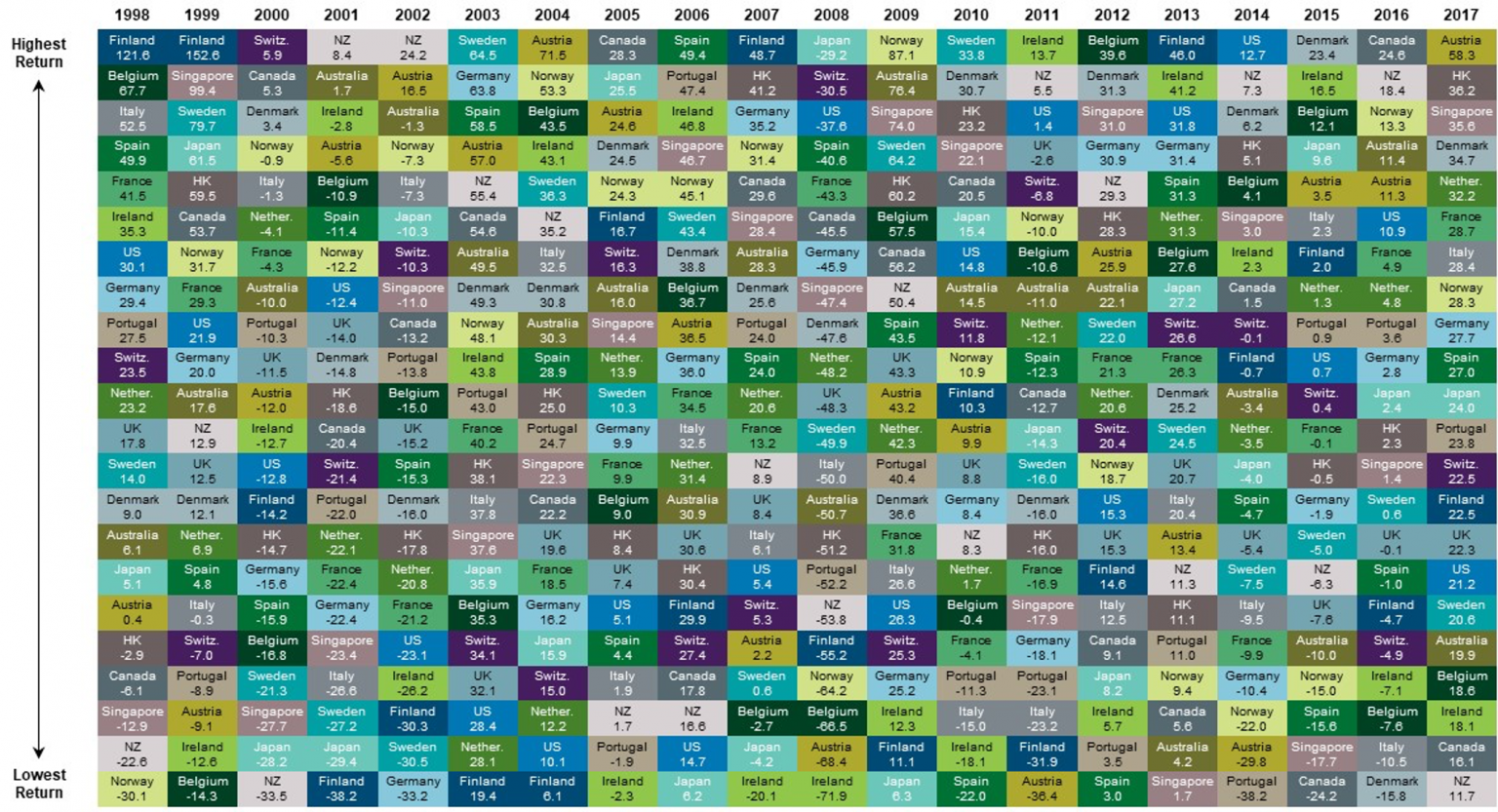
The following graphic illustrates 20 years of annual equity returns for developed markets, with each column sorted from the highest-performing country to the lowest. The quilted, colorful pattern demonstrates the randomness of returns, with no country following any distinct pattern or placement in the ranking over time. The US, for example, was the top-performing country only one out of the last 20 years (2014).


In US Dollars

Source: MSCI country indices (net dividends) for each country listed. Does not include Israel, which MSCI classified as an emerging market prior to May 2010. MSCI data © MSCI 2018, all rights reserved. Past performance is no guarantee of future results. Indices are not available for direct investment; therefore, their performance does not reflect the expenses associated with the management of an actual portfolio.

The Importance of Diversification

We all know that global equity returns are random. But that isn’t something to be feared, and you shouldn’t try to guess which country is going to outperform when. If you have a well-structured, globally diversified portfolio, you are better positioned to capture the performance of the global markets, where and when it occurs. A well-diversified, global portfolio delivers more reliable outcomes over time, helping you stay on track, through all kinds of markets, toward your long-term goals.

Diversify Your Portfolio Today

As of 2017, the US accounted for 52% of the world’s market capitalization, meaning that almost half of the world’s equity investment opportunities lie outside of the US. Failing to diversify is a distinct portfolio weakness. For one, it leaves you at risk in the case of a domestic economic decline, and it also keeps you out of the mix for tremendous internationally-based investment opportunities.

Investment opportunities exist all around the globe. Across more than 40 countries, there are over 15,000 publicly traded companies.2 Don’t miss out on all that the global markets have to offer.

Are you a financial advisor who is interested in growing their business, or an investor who is looking for wealth management advice? Treehouse Wealth is here to help. Contact our team today.

Sources:

1. Definition of “home country bias,” James Chen, Investopedia, June 7, 2018, https://www.investopedia.com/terms/h/home-country-bias.asp, accessed January 2020.
2. Number of countries and publicly traded companies data provided by Bloomberg.

Written By
Treehouse Wealth Advisors Team

Treehouse Wealth Advisors is a women-led firm based in Walnut Creek, CA, dedicated to crafting tailored financial solutions for individuals and families. With a focus on long-term, relationship-driven approaches, we empower clients to invest their time and assets purposefully. Our team is passionate about challenging the status quo and embracing change to find better solutions.

Disclosure:

Form CRS (Client Relationship Summary) is a summary of the services and fees we offer to “retail” investors, which are natural persons who seek or receive services primarily for personal, family, or household purposes.

Click here to download a PDF of Treehouse Wealth Advisors’ Form CRS.

Garrison Point Advisors, LLC doing business as “Treehouse Wealth Advisors” (“TWA”) is an investment advisor based in Walnut Creek, CA and registered with the Securities and Exchange Commission (“SEC”). Registration of an investment advisor does not imply any specific level of skill or training and does not constitute an endorsement of the firm by the Commission. TWA only transacts business in states in which it is properly registered or is excluded or exempted from registration. A copy of TWA’s current written disclosure brochures, Form ADV Part 1 and Part 2A, filed with the SEC which discusses among other things, TWA’s business practices, services, and fees, is available through the SEC’s website at:  www.adviserinfo.sec.gov.

The information provided in this blog is for educational and informational purposes only and is not intended to constitute financial, investment, tax, legal, or accounting advice. The content is general in nature and may not be applicable to your individual circumstances. Nothing herein should be interpreted as a recommendation or solicitation to buy, sell, or hold any security, investment strategy, or financial product.

Readers should not act upon the information contained in this blog without seeking advice from a qualified professional who is familiar with their specific financial situation. Any examples or hypothetical scenarios discussed are for illustrative purposes only and do not guarantee future results.

All opinions expressed are subject to change without notice. While care has been taken to ensure the accuracy of the information presented, no guarantee is made as to its completeness or accuracy, and no liability is assumed for reliance on this content.

Any non-TWA links or websites mentioned in this site are unaffiliated with TWA, and TWA has not been involved in the preparation of the content. In circumstances where we reference non-TWA links, external websites, or third-party content, it should not be construed as an endorsement or adoption by TWA. TWA does not guarantee the accuracy of, or assume any responsibility for, any such content.

Third-party trademarks and service marks are the property of their respective owners. All other trademarks and service marks are the property of TWA.

Related Posts