Resilience, Rewarded
If you had told us in early April that Q2 2026 would turn out to be one of the strongest quarters in recent memory, it would have sounded like wishful thinking. The quarter opened with an active conflict in Iran, gasoline prices that made every trip to the pump a small conversation starter, and a Federal Reserve whose next move was anyone’s guess. And yet here we are. The S&P 500 returned +15.20% for the quarter, its best three-month showing since 2020,1 and international stocks were right behind it, returning +14.49%. The broad bond market also finished modestly positive. If there’s a lesson in it, it’s that recoveries rarely announce themselves. You have to already be in your seat when they start.
A Story in Two Acts: Steadiness Through the First Half, and What It Produced
Q2 makes the most sense when you hold it up next to Q1. For all the alarming headlines that filled the first three months of the year, the actual damage was contained: U.S. equities closed the quarter only modestly lower, international stocks just below flat, and bonds essentially unchanged. It felt worse than it was. The Iran conflict, which began in late February, created genuine uncertainty around oil supply and inflation, and markets reflected that. Investors who stayed the course through that period found themselves well-positioned for what followed.
The second quarter reversed the mood almost entirely. As corporate earnings came in well ahead of expectations and a ceasefire agreement in mid-June offered a path toward normalizing oil supply, equity markets climbed steadily through April and May and accelerated into June.2,3 U.S. large-cap stocks led the way, reaching new all-time highs by the end of the quarter. International equities posted a strong absolute return as well, but as of June 30, they had not fully recovered to their own prior highs. More on that below.
Market Performance: First-Half 2026 Index Returns
January 1 — June 30, 2026 Cumulative total return, indexed to 0%
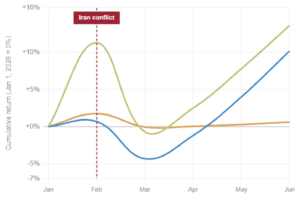
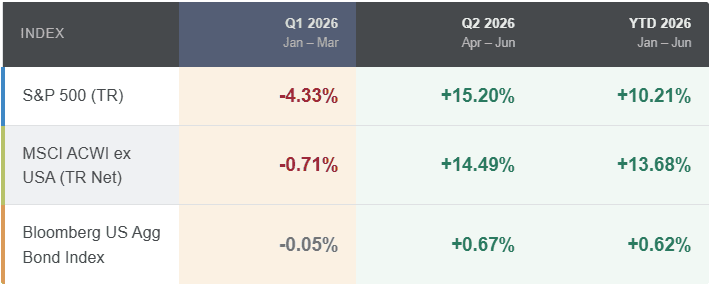
By the close of the second quarter, the S&P 500 had not only recouped its first-quarter decline but had pushed to new all-time highs, finishing the first half up +10.21% on a total return basis. International markets took a longer road back. The MSCI ACWI ex USA Index returned a strong +14.49% for the quarter and +13.68% for the first half, but it entered Q2 in a deeper hole than U.S. stocks. The S&P 500 fell roughly 4% in Q1. International markets, by contrast, had surged more than 11% by late February, then gave nearly all of it back in March once the conflict began. That larger swing meant international stocks had more ground to recover, and as of June 30 the index had not yet reclaimed its prior all-time high.
In our view, two additional factors help explain why the recovery pace differed. International markets, particularly in Europe and parts of Asia, carry more direct exposure to energy costs and global trade disruptions than the U.S. does, and the effects of the first quarter’s oil shock have lingered longer in those economies. Additionally, the U.S. benefited disproportionately from strength in large technology-oriented and artificial intelligence-related sectors, which are more heavily weighted in domestic indices than in international ones. As neither of these dynamics is likely permanent, we continue to believe international diversification plays a meaningful role in a well-constructed portfolio.
On Earnings: The Fundamental Case that Held its Ground

The most encouraging part of the quarter, to us, was that the case for staying invested got backed up by hard numbers, not just optimism. Corporate earnings came in well ahead of expectations. S&P 500 companies reporting first-quarter results during April and May beat analyst estimates by a wide margin. Even better, analysts raised their forward estimates as the quarter went on instead of trimming them, which almost never happens. The five-year norm is a cut of about 2% during any given quarter; this time, estimates rose 3.4%.2 When the earnings picture holds up through a period of geopolitical stress, it tends to anchor equity values, and that is largely what happened here.
Revenue expectations followed a similar path, rising from 9.5% to 12.3% expected growth, which, if realized, would represent the strongest revenue expansion since 2022.5 A meaningful portion of that strength came from the continued buildout of artificial intelligence infrastructure, which is now translating into actual revenue and profit growth across the technology sector and its supply chain. We don’t think the AI investment cycle has fully played out, but we are encouraged to see the earnings story growing alongside the enthusiasm. For long-term investors, that distinction matters. Enthusiasm can fade in a news cycle. Earnings tend to stick around.
Bonds earned their keep this quarter. The Bloomberg U.S. Aggregate Bond Index returned +0.67%, and the steadiness behind that number is the real story. Treasury yields climbed sharply in the early weeks as rate-hike expectations built, then partially reversed once the ceasefire and falling energy prices changed the inflation picture. Through all of it, the broad bond market held its footing. The FTSE 3-Month T-Bill Index added +0.93%, a reminder that short-term holdings are finally being paid something meaningful. That’s what good ballast does: it steadies the ride so the rest of the portfolio can do its work.
The Power of Context: Why Staying the Course Has Historically Been Rewarded

The pattern above isn’t a guarantee. No historical pattern is. But it reflects something we’ve seen play out again and again over decades of headlines that each felt, in the moment, like the one that would change everything: markets have generally found their footing faster than the news cycle would suggest. Just think about the Covid 2020 rebound! Equities recovered all time highs while we were masking and distancing and widespread vaccination still seemed like a pipe dream. Nobody was waiting for permission to feel good again; the market simply moved. This quarter told the same story on a smaller scale. The investors who benefited most from Q2’s recovery were those who were already invested when it began in early April, before the conflict had resolved and before the earnings picture had fully clarified. That is almost always how recoveries work. They don’t wait for comfort.
Looking ahead to the second half, there are still plenty of open questions. Inflation remains a concern and under new leadership the Fed has signaled a continued commitment to its 2% goal.3 So far, the transition at the top of the Fed has gone about as smoothly as anyone could have hoped, and we’re encouraged that the new leadership has been every bit as steady and deliberate as advertised. Still, a steady hand at the Fed doesn’t guarantee a smooth road. Rate expectations remain volatile. Earnings are strong but now priced to a higher bar. And market breadth, while improving, is still narrower than we’d ideally see. None of it strikes us as a reason for alarm, and certainly not a reason to change course. It does argue for the kind of steady, diversified positioning that tends to hold up across a range of outcomes rather than concentrating in whatever has performed best in the recent quarter.
A well-constructed portfolio is designed precisely for moments like the first half of 2026: not just to survive the difficult quarters, but to remain positioned for the ones that follow. That, to us, is what resilience actually means.
As always, we’d love to hear from you, whether it’s a question about your portfolio, a life change worth planning around, or simply a catch-up over coffee.