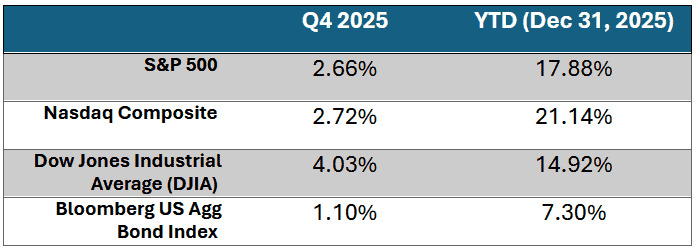
As we close the books on 2025, the fourth quarter served as a fitting “victory lap” for the year. In 2025, US stocks managed to notch their third straight year of double digit gains, although it wasn’t a smooth ride. Political volatility, tariff uncertainty, concerns about the durability of AI’s gains, and the longest government shutdown in US history were just a few concerns that the US stock markets managed to shake off. As seen below, both US stock and bond markets had strong Q4 2025 and full year returns.
A Year of Resilience
The table below highlights key headlines from each quarter and corresponds to the major inflection points in the S&P 500 performance shown above.
Each lettered headline aligns with periods of increased volatility or recovery along the market’s path through 2025.
The headlines in 2025 were, frankly, a lot. Looking back at a year’s worth of headlines, it can be hard to remember that all of this happened in the span of just twelve months. The chart above shows just a few of these headlines and the S&P 500’s growth this year.
Markets kicked off January 2025 with plenty of optimism, but that confidence was tested quickly. Volatility returned in the first quarter as investors wrestled with a familiar mix of concerns: whether the biggest tech leaders were finally losing momentum, and whether rising geopolitical tension would spill into the real economy. The real stress test arrived in early April, when the administration announced sweeping new tariffs. The selloff was sharp: the Nasdaq slid into a confirmed bear market, and the S&P 500 briefly flirted with bear-market territory as investors priced in slower growth and renewed inflation risk.
Then came the oft-repeated reminder that panic is not an investment strategy and by mid-April, it became apparent that these policies were opening negotiations rather than final edicts. The White House signaled flexibility, and risk assets rebounded hard. By late June, U.S. equities had clawed back to fresh highs, capping one of the more dramatic “down-then-up” stretches investors have seen in years.
The back half of the year added its own twists. The third quarter of 2025 marked a pivotal turnaround for the stock market, transforming early-year trade anxieties into a full-blown rally. July was the decisive month, kicking off with the passage of the administration’s “Megabill” and culminating in back-to-back diplomatic breakthroughs: a strategic trade agreement with Japan and a last-minute tariff deal with the EU that averted a feared trans-Atlantic trade war.
In the fourth quarter of 2025, the market’s resilience was tested by another political standoff. The quarter began under the cloud of a government shutdown that commenced on October 1, eventually dragging on to become the longest in U.S. history and causing a sharp spike in volatility. However, the anxiety broke in mid-November when President Trump signed a spending bill to reopen the government, sparking a relief rally that carried into December. The positive momentum was cemented on December 10, when the Federal Reserve cut rates again and signaled a pause in easing, setting the stage for a strong year-end close.
Building the Future: Substance Over Hype
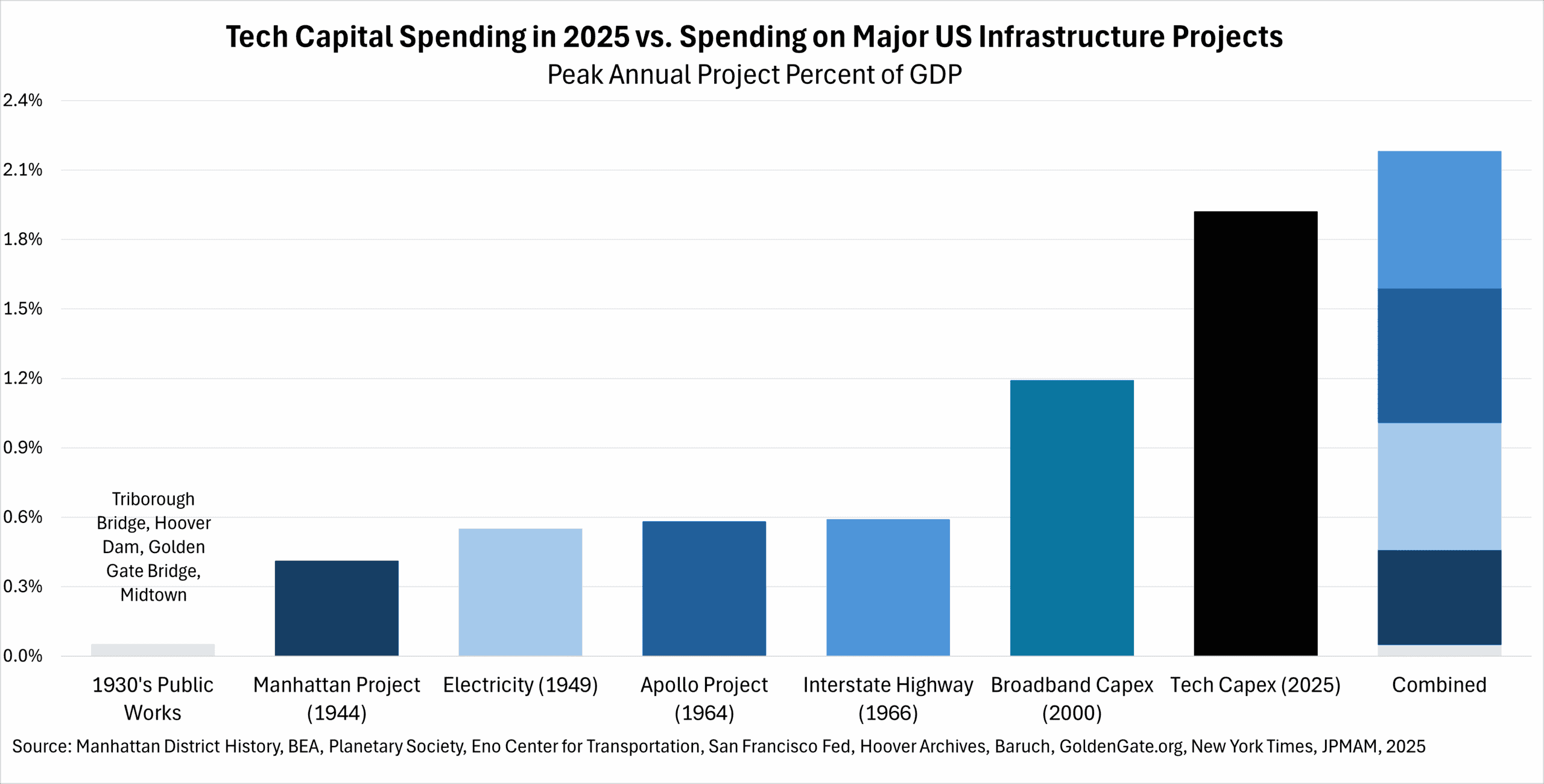
Throughout much of 2025 and especially in the fourth quarter, the debate regarding Artificial Intelligence continued: Is it a bubble, or is it the future? As seen in the chart above, the data emerging suggests that this rally is built on tangible investment, not just speculative fervor. We are witnessing a capital spending cycle that exceeds the most transformative periods in American history. The chart highlights that technology capital spending in 2025 has reached unprecedented levels relative to GDP. This suggests that it’s not merely digital speculation; It is “hard” infrastructure like data centers, power generation, and hardware.
Only time will tell what this means for individual companies – including who will be the winners and who will be the losers – and the investing markets more generally, but this scale of investment suggests that the largest companies in the world are putting their record cash piles to work to build a new industrial backbone. Of course, none of this happens in a vacuum, and this structural growth is unfolding against a complex backdrop. As always, to get a more complete picture, investors will need to continue to look past a frequently volatile news cycle dominated by debates over the Federal Reserve’s independence, the ebb and flow of tariff policies, and geopolitical flashpoints.
An Ode to the Oracle
Finally, we cannot let the quarter pass without acknowledging a monumental shift in the investment landscape: the retirement of Warren Buffett.
For decades, the “Oracle of Omaha” has been our steady hand in volatile times. His departure from the helm of Berkshire Hathaway marks the end of an era, but his philosophy felt particularly present in 2025. One of Buffett’s great lessons was patience (1). His investment philosophy has shown us that the stock market can be a device for transferring money from the impatient to the patient. He reminded us again and again that time in the market beats timing the market; a lesson proven once again this year as those who stayed invested through the Q2 volatility and the October shutdown captured the year’s impressive returns. “Doing nothing” can often be the hardest choice but it is often a great course of action. Last year provided another example where investors who stayed in their seats were rewarded for their patience.
Warmly,
Your TWA Team
Sources:

Q4 2025 Commentary: A Strong Finish to a Resilient Year
As we close the books on 2025, the fourth quarter served as a fitting “victory lap” for the year. In 2025, US stocks managed to notch their third straight year of double digit gains, although it wasn’t a smooth ride. Political volatility, tariff uncertainty, concerns about the durability of AI’s gains, and the longest government shutdown in US history were just a few concerns that the US stock markets managed to shake off. As seen below, both US stock and bond markets had strong Q4 2025 and full year returns.

A Year of Resilience
The table below highlights key headlines from each quarter and corresponds to the major inflection points in the S&P 500 performance shown above.
Each lettered headline aligns with periods of increased volatility or recovery along the market’s path through 2025.
The headlines in 2025 were, frankly, a lot. Looking back at a year’s worth of headlines, it can be hard to remember that all of this happened in the span of just twelve months. The chart above shows just a few of these headlines and the S&P 500’s growth this year.
Markets kicked off January 2025 with plenty of optimism, but that confidence was tested quickly. Volatility returned in the first quarter as investors wrestled with a familiar mix of concerns: whether the biggest tech leaders were finally losing momentum, and whether rising geopolitical tension would spill into the real economy. The real stress test arrived in early April, when the administration announced sweeping new tariffs. The selloff was sharp: the Nasdaq slid into a confirmed bear market, and the S&P 500 briefly flirted with bear-market territory as investors priced in slower growth and renewed inflation risk.
Then came the oft-repeated reminder that panic is not an investment strategy and by mid-April, it became apparent that these policies were opening negotiations rather than final edicts. The White House signaled flexibility, and risk assets rebounded hard. By late June, U.S. equities had clawed back to fresh highs, capping one of the more dramatic “down-then-up” stretches investors have seen in years.
The back half of the year added its own twists. The third quarter of 2025 marked a pivotal turnaround for the stock market, transforming early-year trade anxieties into a full-blown rally. July was the decisive month, kicking off with the passage of the administration’s “Megabill” and culminating in back-to-back diplomatic breakthroughs: a strategic trade agreement with Japan and a last-minute tariff deal with the EU that averted a feared trans-Atlantic trade war.
In the fourth quarter of 2025, the market’s resilience was tested by another political standoff. The quarter began under the cloud of a government shutdown that commenced on October 1, eventually dragging on to become the longest in U.S. history and causing a sharp spike in volatility. However, the anxiety broke in mid-November when President Trump signed a spending bill to reopen the government, sparking a relief rally that carried into December. The positive momentum was cemented on December 10, when the Federal Reserve cut rates again and signaled a pause in easing, setting the stage for a strong year-end close.
Building the Future: Substance Over Hype
Throughout much of 2025 and especially in the fourth quarter, the debate regarding Artificial Intelligence continued: Is it a bubble, or is it the future? As seen in the chart above, the data emerging suggests that this rally is built on tangible investment, not just speculative fervor. We are witnessing a capital spending cycle that exceeds the most transformative periods in American history. The chart highlights that technology capital spending in 2025 has reached unprecedented levels relative to GDP. This suggests that it’s not merely digital speculation; It is “hard” infrastructure like data centers, power generation, and hardware.
Only time will tell what this means for individual companies – including who will be the winners and who will be the losers – and the investing markets more generally, but this scale of investment suggests that the largest companies in the world are putting their record cash piles to work to build a new industrial backbone. Of course, none of this happens in a vacuum, and this structural growth is unfolding against a complex backdrop. As always, to get a more complete picture, investors will need to continue to look past a frequently volatile news cycle dominated by debates over the Federal Reserve’s independence, the ebb and flow of tariff policies, and geopolitical flashpoints.
An Ode to the Oracle
Finally, we cannot let the quarter pass without acknowledging a monumental shift in the investment landscape: the retirement of Warren Buffett.
For decades, the “Oracle of Omaha” has been our steady hand in volatile times. His departure from the helm of Berkshire Hathaway marks the end of an era, but his philosophy felt particularly present in 2025. One of Buffett’s great lessons was patience (1). His investment philosophy has shown us that the stock market can be a device for transferring money from the impatient to the patient. He reminded us again and again that time in the market beats timing the market; a lesson proven once again this year as those who stayed invested through the Q2 volatility and the October shutdown captured the year’s impressive returns. “Doing nothing” can often be the hardest choice but it is often a great course of action. Last year provided another example where investors who stayed in their seats were rewarded for their patience.
Warmly,
Your TWA Team
Sources:
Disclosure:
Form CRS (Client Relationship Summary) is a summary of the services and fees we offer to “retail” investors, which are natural persons who seek or receive services primarily for personal, family, or household purposes.
Click here to download a PDF of Treehouse Wealth Advisors’ Form CRS.
Garrison Point Advisors, LLC doing business as “Treehouse Wealth Advisors” (“TWA”) is an investment advisor based in Walnut Creek, CA and registered with the Securities and Exchange Commission (“SEC”). Registration of an investment advisor does not imply any specific level of skill or training and does not constitute an endorsement of the firm by the Commission. TWA only transacts business in states in which it is properly registered or is excluded or exempted from registration. A copy of TWA’s current written disclosure brochures, Form ADV Part 1 and Part 2A, filed with the SEC which discusses among other things, TWA’s business practices, services, and fees, is available through the SEC’s website at: www.adviserinfo.sec.gov.
The information provided in this blog is for educational and informational purposes only and is not intended to constitute financial, investment, tax, legal, or accounting advice. The content is general in nature and may not be applicable to your individual circumstances. Nothing herein should be interpreted as a recommendation or solicitation to buy, sell, or hold any security, investment strategy, or financial product.
Readers should not act upon the information contained in this blog without seeking advice from a qualified professional who is familiar with their specific financial situation. Any examples or hypothetical scenarios discussed are for illustrative purposes only and do not guarantee future results.
All opinions expressed are subject to change without notice. While care has been taken to ensure the accuracy of the information presented, no guarantee is made as to its completeness or accuracy, and no liability is assumed for reliance on this content.
Any non-TWA links or websites mentioned in this site are unaffiliated with TWA, and TWA has not been involved in the preparation of the content. In circumstances where we reference non-TWA links, external websites, or third-party content, it should not be construed as an endorsement or adoption by TWA. TWA does not guarantee the accuracy of, or assume any responsibility for, any such content.
Third-party trademarks and service marks are the property of their respective owners. All other trademarks and service marks are the property of TWA.
Subscribe to Our Newsletter
Related Posts
Q3 2026 Market Commentary – Between the Headlines
The Federal Reserve raised interest rates in September for the first time since 2023, driving Treasury yields to levels we haven’t seen since 2007.
Advanced Estate Planning Strategies for High-Net-Worth Families
Advanced estate planning strategies for high-net-worth families can help reduce taxes, improve family coordination, and protect long-term legacy goals.
Treehouse Wealth Book Club Recap: Exploring Libby DeLana’s “Do Walk”
Treehouse Wealth reflects on Libby DeLana’s Do Walk and the book club’s conversation about walking, mindfulness, connection, and community.